


Food and Lodging
You can help on our farm in exchange for food and lodging.
long term
We have place for two, max. three long term volunteers. They stay for months. They have a room with Ine and Dirk in the house. We need a bit of match here, from both sides. Therefore, the first weeks are actually a try out period.
Long term volunteers help managing the farm and host short term volunteers and guests. They are of big value because they know where everything is and how it works, so we can welcome, reach and help more people. They are involved in planning, organising and deciding. Skills that ask more time to master become an option. Think of making sourdough bread in the big stone oven, repair bikes, manage your own piece of the garden, become good at some crafts like willow baskets or spoon making, … Long term volunteers can also help with communication, website or administration.
In winter, we only have long term volunteer as part of a longer exchange. They stay, for example, after having been at our place in late summer and autumn or come for a school year or calendar year, including winter.
If you want to come for a long term, check for sure if you could apply for the ESC or Bel-J programs. Also outside of this programs, volunteers can stay for a longer time.
short term
Short term volunteers stay for two weeks to max. two months. They come mostly in summer and stay in the barn, where they sometimes share a room, or they camp. They have less to say in the work and the organisation and have less learning opportunities. How many short term volunteers we can host, depends on the number of long term volunteers and how well they are worked in. Sometimes in summer we are a group of ten, but you can also be alone with the family for a while.
Sometimes we organise a ESC summer team. Young people from abroad come to help for two to eight weeks. It’s a special experience to start and finish with a group of young people to experience this life close to nature.
organisation of day and week
Every morning at 8h00 the work of the day is discussed. Most days we work until early afternoon, of course with a break for lunch. We work about five hours in total. After that there is time for relaxation, personal projects or tasks. This structure can be turned completely upside down if we have an urgent task, an unexpected opportunity crosses our path or we have to take the weather into account.
We work Sunday until Thursday (included). Friday and Saturday are free days. Also this is changed when needed or on demand from ourselves or the volunteers.
Volunteers that stay for a longer time or search for the real ‘living of the land’ experience, often work along ‘non-stop’, on the rhythm of the of the weather, what there is to do on the farm and what they want to try out themselves. The barriers between work, free time and game fade of get a different meaning.
accomodation
The accommodation is simple.
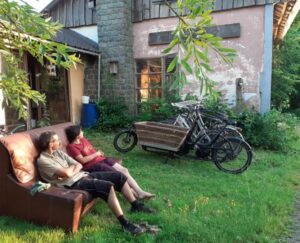
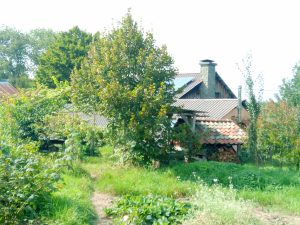
Long term volunteers get their own room, sometimes shared with another long-term volunteer. The short term volunteers have to share a room more often. Sometimes they even camp. We have some tents available.
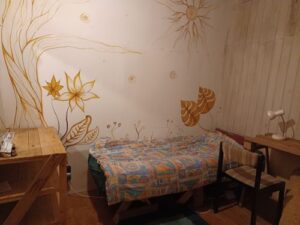
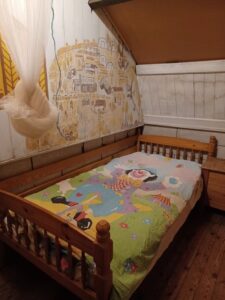
In the rooms, there is a bed, a shelve, a light and electricity. Volunteers can help ‘pimping’ the rooms (with material from the second-hand shop or natural materials). The rooms on the pictures, for example, are painted with home made quark-chalk paint and iron-oxide pigments.
Bed linnen is available: mattresses, mattress covers, duvet covers, blankets, pillows and mosquito nets.
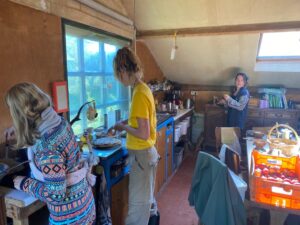
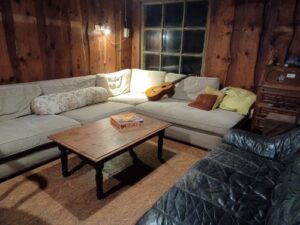
In the summer we lodge in a former barn that was rented out to the local youth organisations already by the former owner. There is a spacey kitchen with a rocket stove. The polyvalent room with coach, chairs and tables is used for activities but is also available for volunteers.
food
The volunteers and the inhabitants cook (together) taking turns. It’s possible that some cook a bit more or less then the rest and then take less or more other taks. Everyone has different talents, but we need to have food on the table eventually.
Our food is
- seasonal (no cucumbers in April, eggs in September or pumpkins in August)
- local (apple juice in stead of orange juice but also no coffee, chocolate or peanut butter)
- organic
- mainly organic with limited dairy products; if you want to (learn to) make yoghurt or choose, we can get fresh raw (non organic) milk from a local farmer. You avoid package by using our own glass bottles to get the milk by bike 4 km further
- as much as possible not or self processed
In winter we cook on the rocket stove. We have mainly basic products. We buy some organic and as local as possible grains, seeds, nuts, oil and legumes in big paper bags or jars (avoiding package) and we grow a lot of fruits and some vegetables and herbs. It’s up to the volunteers to change that into meals, deserts, bread and spreads (hummus, jam, pesto, apple syrup, vegetable paté etc.) and other tasty things like pickles, choucroute, mayonaise, garlic butter, flavoured syrups or crumble. The flower comes from a local mill that buys the grain from local organic producers.
For breakfast, the main food is fruit. Fresh in the season (which is, with the basement full of apples, almost the whole year), dried or stored as juice, compote or jam. Those who like, can have oat porridge with it. To avoid dairy, we make the porridge with water and apple juice.
For lunch, we have leftovers from last day’s meal, soup or salad with home made sourdough bread and spreads.
At diner, we cook a meal with vegetables, nuts and grains or potatoes and sometimes some dairy. Occasionally we cook a bit of meat from our own sheep or we have some salvaged food.
For the small hunger in between or the breaks there is (dried) fruit or home made smoothie.
sanitary
In the summer there is a very basic outside shower with warm (if there was sun to heat it) and cold water.
Er is een buitendouche met warm (als de zon geschenen heeft) en koud water in de zomer. Omdat de regenwatervoorraad beperkt is, wordt er ‘functioneel’ gedoucht, dus om vuil of zweet af te spoelen. In de winter wordt de badkamer gedeeld met het gezin. Water wordt dan opgewarmd op de kachel en je wast je uit een emmer warm water, aangezien de zon er in de winter meestal niet in slaagt de zonneboiler voldoende op te warmen.
In de schuur beschikken de vrijwilligers over een afsluitbare toiletruimte met wasbak met koud regen- en drinkwater en een composttoilet.
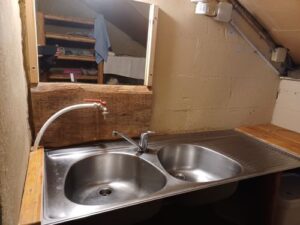
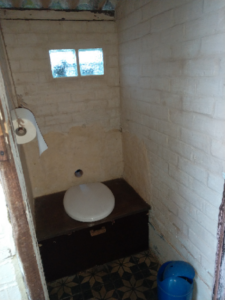
Er zijn verder nog twee composttoiletten buiten.
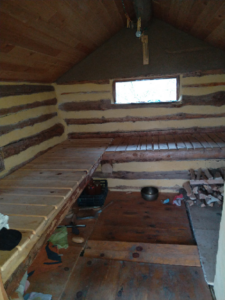
In een zelfgebouwde blokhut/sauna/badhuis kan winter en zomer op een rocket-mass houtkachel water opgewarmd worden voor een privé afspoelsessie. Zeep is hier niet toegelaten. In het koude seizoen wordt de sauna meestal wekelijks gestookt.
Er is zeep beschikbaar op het project. Nog beter (voor de natuur en je huid) is het om het gebruik van zeep zoveel mogelijk te beperken. Als je zelf je zeep meebrengt, overweeg vaste zeep in plaats van vloeibare. Zorg in elk geval dat ze bio-afbreekbaar is.
verwarming
Alle verwarming gebeurt met rocket-mass houtkachels die ‘s avonds en soms nog een tweede of zelfs derde keer worden gestookt, afhankelijk van hoe hard de winter toeslaat. Alleen de keuken wordt zo verwarmd. De slaapkamers zijn niet verwarmd. Er zijn voldoende dekens en warmwaterkruiken voor de winter. Warm water voor hete dranken of om (je) te wassen is alleen beschikbaar na die stookmomenten of kan in thermossen warmgehouden worden.
verdere is er
- WIFI.
- een wasmachine; we maar gooien alle was meestal samen op lage temperatuur, om geen energie en geen tijd te verspillen. Je brengt dus best kleren (en vooral ondergoed) mee die je duidelijk kan herkennen.
- gezelschapsspelletjes
- rubber laarzen in verschillende maten, buitenschoenen, winter- en regenjassen en kleding
- (bad)handdoeken
omgeving
Onze akker ligt tegen de ‘top’ van Pullem berg. Op Laaistok stond ooit een windmolen! De hoeve ligt aan de voet van de akker, op een richel waaronder een steile afdaling begint, met nog even een plateautje ertussen, naar de Sassegembeek (één van de bronbeken van de Zwalm). Het gebied onder de hoeve (ongeveer twee derde van de totale vier hectaren) maakt deel uit van een natura 2000 gebied dat de vallei van de Sassegembeek volgt. Een kwetsbaar natuurgebied waar de voorzichtige wandelaar mooie schatten kan ontdekken. Op tien minuten wandelen vind je de rand van het Brakelbos dat je op haar beurt weer, langs z’n brede beukenlanen en heimelijke kleine paadjes, naar de cafeetjes bij de grens met Wallonië voert in La Houpe of D’Hoppe.
De Vlaamse Ardennen is één van de mooiste regio’s in Vlaanderen, met een heuvelachtig en vaak verrassend landschap. Op vier kilometer is er de dorpskern van Brakel met winkels, een zwembad en een gezellige bibliotheek. Op 12 tot 14 kilometer vind je de kleine stadskernen van Ronse, Zottegem, Oudenaarde en Geraardsbergen.
iets voor jou?
Houd er rekening mee dat dit leven wat meer (tijd) vraagt dan wanneer je in een stadshuis leeft. Composttoiletten moeten geleegd worden en hun schaafselvoorraad moet worden aangevuld. Een houtkachel stoken kost meer tijd dan een knop omdraaien. Groenten moeten geoogst en schoongemaakt worden. Was wordt opgehangen, in de winter soms voor een paar dagen, binnengehaald en (in de winter) op de kachel nagedroogd. De waterketel moet gevuld worden als je warm water wil in de winter en warm water van de zonneboiler moet aangesleept worden voor de afwas in de schuur in de zomer. Als je dit soort leven een tijdje wil meebeleven of uitproberen, dan is dit jouw project. Indien niet, dan kan het frustrerend worden.
drugs
Boskanter is een rookvrije plek. Drugs hebben hier geen plaats en alcohol hoort bij speciale gelegenheden.